
Peer review is a critical checkpoint in the scholarly publishing pipeline. It not only ensures scientific quality, but also helps detect and deter unethical practices such as plagiarism. This article explores how peer review processes serve as a filter for plagiarism, what tools are used, and how reviewers, editors, and authors can contribute to academic integrity.
1. The Role of Peer Review in Academic Honesty
Peer review is a process where independent experts evaluate a manuscript before it is published. While its primary purpose is to assess the scientific value and quality of research, it also functions as a gatekeeper for ethical issues such as:
- Plagiarism (text, ideas, data)
- Self-plagiarism or redundant publication
- Improper citation or authorship practices
2. How Reviewers Detect Plagiarism
Experienced reviewers can often recognize signs of copied material, such as:
- Inconsistent writing style or sudden shifts in tone
- Highly polished passages without references
- Unfamiliar or unexplained concepts that should be cited
“Plagiarism not only violates the author’s credibility, it erodes trust in the academic system.” — COPE (Committee on Publication Ethics)
3. Tools That Help
Journals and reviewers often use software to screen submissions before or during the peer review process. Popular plagiarism detection tools include:
- iThenticate: Used by major publishers (Elsevier, Springer) to detect text overlap
- Turnitin: Common in academic institutions, often used for student papers
- PlagScan, Grammarly Business, Quetext: Also provide plagiarism scores and detailed reports
4. When Plagiarism is Detected
When plagiarism is identified—either by software or a human reviewer—the editorial board assesses its scope and intent. Based on whether the plagiarism appears to be minor and unintentional, or significant and deliberate, different consequences may follow. These can range from mild corrections to severe academic sanctions:
- Manuscript Rejection: If substantial plagiarism is found, the journal may reject the submission outright, often without allowing resubmission. This is particularly true for cases involving copied text without quotation or citation.
- Requests for Revision and Proper Citation: In cases of minor overlap (e.g., missing quotation marks or paraphrased content without citation), the editor may give the author an opportunity to revise the manuscript with proper references and formatting.
- Formal Warning to the Author: Some journals issue written warnings to authors, especially for first-time or student contributors, accompanied by educational resources about ethical writing.
- Notifications to Affiliated Institutions: If the issue is serious or recurrent, the editor may contact the author’s university, department, or funding agency. Institutions often initiate their own investigation, which can affect the author’s reputation, employment, or degree progress.
- Retractions of Already Published Articles: If plagiarism is discovered after publication, the journal may issue a formal retraction notice, which remains publicly accessible and is indexed in databases like PubMed and CrossRef. Retractions can severely damage an author’s academic credibility.
- Publication of Retraction or Correction Notices: Some journals publish a correction or “expression of concern” if only certain parts of the work are problematic, while others opt for full retraction with an explanation.
- Blacklisting of Authors in Extreme Cases: Authors involved in multiple or egregious ethical violations may be banned from submitting to the journal or publisher in the future. Some publishers also share these blacklists across journals or societies.
- Loss of Research Grants or Academic Positions: In the most severe cases, plagiarism can lead to revoked grants, academic probation, or termination of employment, especially when research misconduct is confirmed by the affiliated institution.
Editors typically follow the guidance of organizations like COPE (Committee on Publication Ethics) when deciding how to respond to plagiarism cases. Transparency and due process are crucial to ensure fair and consistent handling.
5. Real-World Retractions Due to Plagiarism
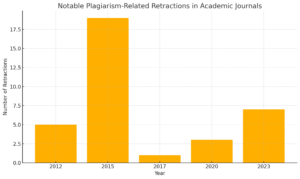
The chart below illustrates selected known cases of plagiarism-related retractions in peer-reviewed journals across various years and publishers:
6. How Authors Can Protect Themselves
To avoid unintentional plagiarism and uphold their credibility, authors should take a proactive approach at every stage of writing and submission. Here are practical steps authors can follow:
- Use plagiarism checkers before submission: Tools like Plagiarismsearch, Turnitin, and iThenticate can identify text overlaps and help you revise before peer review begins.
- Always cite your sources — even when paraphrasing: Rephrasing content does not eliminate the need for citation. Provide accurate references for all borrowed ideas, facts, or data.
- Document your sources and drafts: Keeping a clear record of where your information comes from and how your work evolved can help defend your originality if questioned later.
- Understand self-plagiarism: Reusing significant parts of your previous publications without disclosure or citation is considered unethical. Always cite your own earlier work and explain when content overlaps.
- Avoid simultaneous submissions: Do not submit the same or slightly modified manuscript to multiple journals at once. This is considered unethical and can lead to blacklisting.
- Use AI tools responsibly: When using AI (e.g., for grammar correction or content suggestions), always perform a human review. Never pass AI-generated content as original research without validation and proper attribution if relevant.
- Familiarize yourself with journal policies: Each journal may have specific rules regarding text similarity, citation style, and ethical declarations. Read them before submission.
- Consult with a mentor or editor: If unsure, seek guidance from a senior researcher, academic supervisor, or professional editor with knowledge of publication ethics.
7. Conclusion
Peer review remains an essential component in upholding the ethical standards of scientific publishing. With the support of trained reviewers, editorial policies, and technology, the academic community continues to improve its ability to detect and prevent plagiarism. Authors must also take proactive responsibility to ensure originality and transparency.
Academic Misconduct Policies: How Different Universities Define Plagiarism
Policy snapshot: July 2026. University-wide rules may be supplemented by faculty, department, course, and assessment instructions. Universities broadly agree that students must not present another person’s work or ideas as their own. Yet their academic misconduct policies do not use identical definitions. They differ in how they treat intention, previous work, collaboration, artificial intelligence, non-text […]
The Role of Teachers in Preventing Plagiarism Before It Happens
Plagiarism prevention begins long before a student submits a final paper. By the time copied or poorly attributed material appears in a completed assignment, the student may already have struggled with research, note-taking, paraphrasing, time management, or unclear instructions. Some students plagiarize intentionally. Others do it because they do not understand where their own wording […]
AI Note-Taking Apps 2025: Otter, Notta, Fireflies & Others Compared
AI note-taking apps became much more than transcription tools in 2025. The leading platforms could record meetings, identify speakers, generate summaries, extract action items, answer questions about past conversations, and send information into workplace systems. However, the apps did not offer the same experience. Some joined meetings as visible bots. Others captured audio directly from […]